Asia
Hyperbaric
Centre

Who Is
This For?
This supportive protocol is for people whose bone infection has persisted or returned despite appropriate surgical and antibiotic management — the definition of "refractory" — and whose orthopaedic or infectious disease team recommends an adjunctive approach.
It is most appropriate for:
Refractory infection after standard care: You have had adequate surgical debridement and culture-directed antibiotics, and the infection has still persisted or recurred.
Advanced disease: Cierny-Mader Stage 3 or 4 osteomyelitis, where the UHMS gives adjunctive hyperbaric oxygen its stronger (Class IIa) recommendation [1].
High-stakes sites: Infection in the spine, skull, or sternum, where extensive surgery carries high risk and your team wants the tissue optimised before operating [1].
Infection within a diabetic foot ulcer: Wagner Grade 3 or 4 ulcers with underlying bone infection — the scenario where the UHMS recommendation is strongest (Class I) [1]. This overlaps directly with our diabetic foot ulcer protocol.
This protocol never replaces surgery or antibiotics. It exists to make them work. A doctor's referral is required before we begin — ideally timed to start soon after surgical debridement, when the evidence says the combination is most effective [1].
The defining moment is recurrence. One treated infection is a battle; a second or third recurrence is a pattern — and the pattern usually means the bone's circulation, not the antibiotic, is the limiting factor [1] [2].
You should discuss hyperbaric oxygen with your specialist when:
Infection has returned despite one or more completed courses of appropriate antibiotics.
Your surgeon is planning further debridement and wants hyperbaric oxygen started alongside it — the UHMS notes the best results come when sessions begin soon after thorough debridement, alongside culture-directed antibiotics [1].
The infected site is somewhere surgery alone cannot safely reach — deep vertebral, cranial, or sternal infection.
You are facing amputation for refractory infection of a limb, and your team agrees there is still something left to try before it.
A diabetic foot ulcer has reached bone, and infection keeps breaking through.
When to Consider HBOT
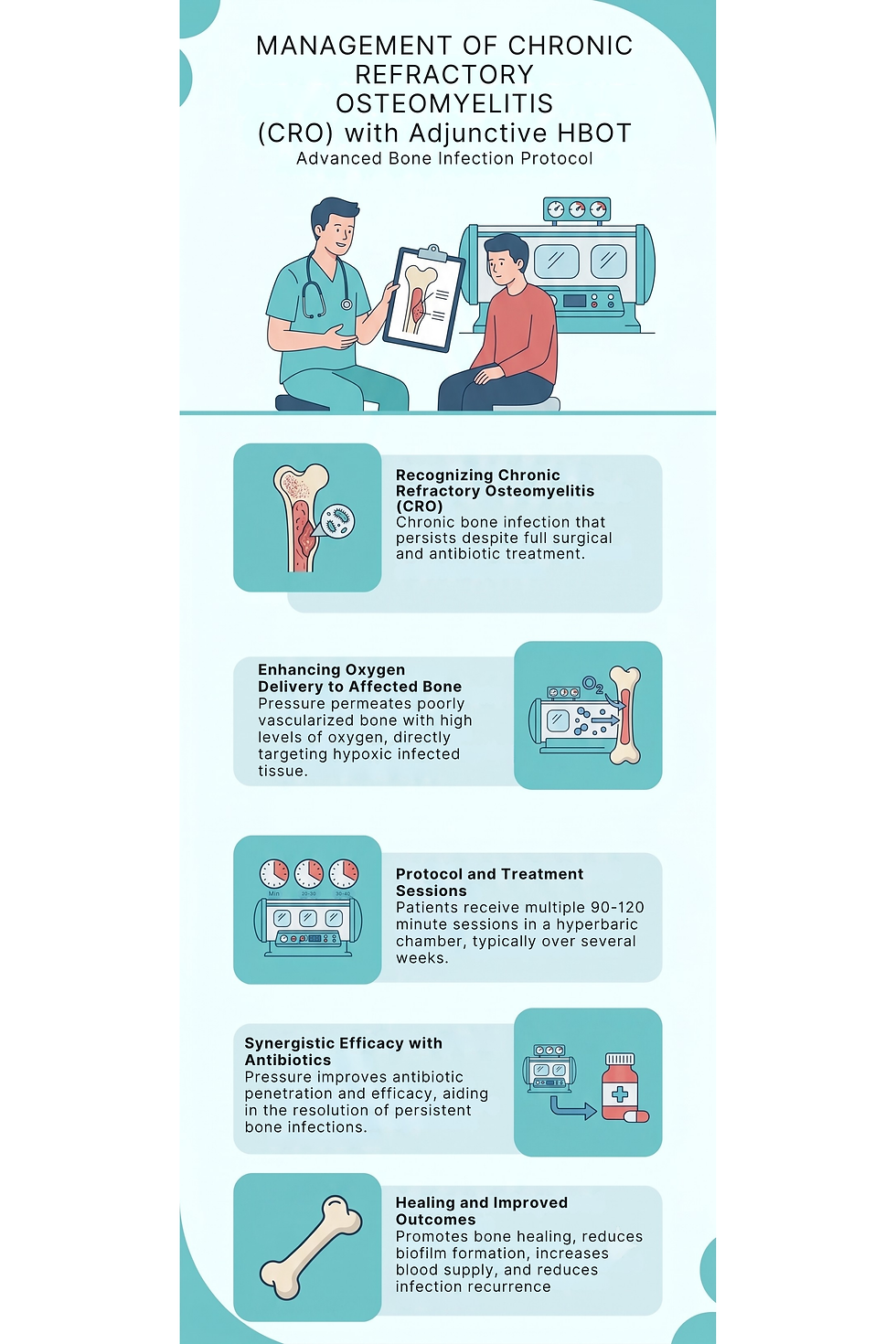
Giving Your Immune System Its Oxygen Back
Chronic bone infection survives because of where it lives. Damaged, infected bone is low on blood supply and therefore low on oxygen — in animal studies, oxygen tension inside infected bone falls to roughly half the normal level [2]. In that environment, three failures compound. Your neutrophils — the white blood cells that kill bacteria — cannot run the oxygen-dependent chemistry that destroys them. Several major antibiotics lose potency without adequate oxygen. And the bone cannot rebuild, because repair cells are oxygen-starved too [1] [2].
More antibiotics cannot fix this. The drug arrives by blood, and the blood is not reaching the target.
Inside the chamber, we change the physics. At 2.0 to 2.5 ATA, 99.5% medical-grade oxygen dissolves directly into the blood plasma, bypassing red blood cells entirely. In the classic experiments, oxygen tension in infected bone rose from hypoxic levels back to — and above — normal under hyperbaric conditions [2].
Three things follow.
First, neutrophil killing switches back on. Restored oxygen tension re-enables the oxidative burst your immune cells use to destroy bacteria [1] [2].
Second, antibiotics regain their footing. Oxygen-dependent antibiotic transport and activity recover, and improving circulation physically delivers more drug to the site [1].
Third, the bone resumes its own work. Osteoclasts clear dead and infected bone more effectively, and new micro-vessel growth brings a lasting blood supply to the zone [1] [2].
The bacteria were never the whole problem. The hypoxic bone protecting them was. That is what this protocol targets.
The Science & Clinical Evidence
We do not make promises. The research does that — and on this page, precision about the evidence matters more than anywhere, because of what kind of evidence this is.
Refractory osteomyelitis is an established UHMS indication for adjunctive hyperbaric oxygen, carrying an American Heart Association Class II recommendation — Class IIa for advanced disease, and Class I when bone infection complicates a severe diabetic foot ulcer [1]. The foundation is a large and consistent body of surgical series.
The most comprehensive systematic review gathered 45 studies covering 460 people with chronic osteomyelitis — every one of whom had already received antibiotics and surgical debridement [3]:
73.5% — the proportion achieving successful resolution with no reported relapse when hyperbaric oxygen was added to surgery and antibiotics, across 419 cases with complete data. — Savvidou et al., Orthopedics, 2018 [3]
Earlier series tell the same story at single centres:
92% — complete eradication of refractory femoral osteomyelitis (12 of 13 cases) with adjunctive hyperbaric oxygen after adequate debridement and antibiotics. — Chen et al., Chang Gung Medical Journal, 2004 [4]
34 of 38 — clients with chronic refractory osteomyelitis remaining free of infection signs at an average of 34 months after combined management including hyperbaric oxygen. — Davis et al., 1986 [5]
And a 2025 cohort analysis added a modern data point: people who completed their hyperbaric oxygen course had nearly eight times the odds of improvement compared with those who did not [6].
Where we are honest with you: there are no large randomized controlled trials in this field — the UHMS says so itself [1]. One older non-randomized comparative study found no significant benefit [7], and the systematic reviews rest on uncontrolled series of people who had already failed standard care. The signal is consistent across decades and centres, but it is an association, not proof. Surgery and culture-directed antibiotics remain the foundation. Our role is adjunctive — and if your specialist judges your case unlikely to benefit, we will say the same.

Our protocols follow UHMS guidance for refractory osteomyelitis [1]. The schedule is built around your surgical and antibiotic plan — not the other way around.
Oxygen Purity: 99.5% Medical-Grade Oxygen — pharmaceutical-grade purity certified under the Pharmacy and Poisons Ordinance (Cap. 138) [8].
Chamber Pressure: 2.0 to 2.5 ATA (Atmospheres Absolute) — the range used across the published series [1] [3].
Session Duration: 90 minutes at depth.
Frequency: Once daily, 5 days per week.
Timing: Ideally begun soon after surgical debridement, running alongside your culture-directed antibiotic course [1].
Total Course: Typically 20 to 40 sessions (approximately four to six weeks), continued while clinical improvement is seen, and reviewed with your specialist [1].
The Protocol
What To Expect
We understand that entering a hyperbaric chamber can feel unfamiliar. Our team is here to guide you through every step of the process, ensuring you feel comfortable, safe, and supported.
Step 1 — The Briefing & Preparation: Before your first session, our technician will walk you through the safety protocols. You will change into 100% cotton clothing (provided) to eliminate static risk. No electronics, watches, or oil-based cosmetics are allowed inside the chamber.
Step 2 — Pressurisation: As the chamber pressurises over 10-15 minutes, you will feel a sensation in your ears similar to descending in an airplane. Our technician will coach you on simple techniques to clear your ears. Once at depth (2.0-2.4 ATA), you will breathe 99.5% pure oxygen through a comfortable hood or mask. You can read, rest, or watch a screen during the 90-minute session.
Step 3 — Depressurisation & Next Steps: The chamber will slowly depressurise over 10-15 minutes. Once open, you can return to your normal daily activities immediately. Our technician will examine your wound site and coordinate with your primary wound care team to track your progress.

FAQ
How many sessions before I notice a difference?
Most protocols run 20 to 40 sessions over four to six weeks, alongside your antibiotics [1]. Because response is measured by your specialist — through wound appearance, blood markers, and imaging — rather than by feel, we review progress formally with your team as the course proceeds. The UHMS guidance is simple: continue while improvement is seen.
Can hyperbaric oxygen cure my bone infection by itself?
No — and we will never frame it that way. Every study behind this page used hyperbaric oxygen as an *adjunct* to surgery and culture-directed antibiotics, not a substitute \[1] \[3]. Think of it this way: antibiotics and surgery are the treatment; hyperbaric oxygen restores the oxygen-starved conditions those treatments need to succeed. If someone offers you oxygen instead of surgery and antibiotics, walk away.
I have already failed multiple treatments. Why would this be different?
Because it addresses a different part of the problem. Your previous treatments attacked the bacteria. The evidence suggests refractory infection persists largely because the bone is too oxygen-starved for immune cells and antibiotics to work [1] [2]. Hyperbaric oxygen targets that environment — which is why, in the systematic review, nearly three in four people who had failed standard care resolved without reported relapse once it was added [3]. Not a guarantee. A different lever, with evidence behind it.

UHMS. Osteomyelitis (Refractory). UHMS Hyperbaric Oxygen Therapy Indications, 15th Edition. Undersea and Hyperbaric Medical Society. UHMS Official Indications
Mader JT, et al. Hyperbaric oxygen and experimental osteomyelitis: restoration of intramedullary oxygen tensions and phagocytic function (mechanism studies). As summarized in UHMS Indications, Ch. Refractory Osteomyelitis.
Savvidou OD, Kaspiris A, Bolia IK, et al. Effectiveness of hyperbaric oxygen therapy for the management of chronic osteomyelitis: a systematic review. Orthopedics. 2018;41(4):193-199.
Chen CE, Ko JY, Fu TH, Wang CJ. Results of chronic osteomyelitis of the femur treated with hyperbaric oxygen: a preliminary report. Chang Gung Med J. 2004;27(2):91-97. PubMed 15095953
Davis JC, et al. Chronic non-hematogenous osteomyelitis treated with adjuvant hyperbaric oxygen. 1986. [UNVERIFIED — full citation to be confirmed before publication; 34 of 38 cases free of infection signs at mean 34 months]
Jackson JB 3rd, Bakaes Y, Jacques B, et al. Adjunctive hyperbaric oxygen therapy for patients with chronic refractory osteomyelitis: a report of treatment outcomes and risk factors for treatment failure. Adv Skin Wound Care. 2025;38(1):40-45.
Esterhai JL, et al. Adjunctive hyperbaric oxygen therapy in the treatment of chronic refractory osteomyelitis (non-randomized comparative study finding no significant benefit). As reviewed in CMS Technology Assessment, 1999. [UNVERIFIED — full citation to be confirmed before publication]
Hong Kong e-Legislation. Pharmacy and Poisons Ordinance (Cap. 138). Cap. 138 on e-Legislation